Anti Rotation Exercises for Next Level Core
Crunches, sit-ups and planks have dominated core training for decades. They can all be useful exercises, but if your goal is to build a core that helps you lift, run, play sport and protect your back, there is another type of training that deserves much more attention: anti-rotation training.
Anti-rotation exercises train your core to prevent unwanted twisting of the trunk rather than creating movement.
That might not sound particularly exciting, but resisting movement is one of the most important jobs your core performs.
Whether you’re carrying a heavy suitcase, lifting something with one hand, running, throwing, swinging a golf club or simply moving an awkward object around the garden, forces are constantly trying to rotate your pelvis and spine.
A strong core helps you control those forces.
And this becomes particularly important as we get older.
What is anti-rotation core training?
Your core isn’t simply your abdominal muscles.
It’s a complex system of muscles surrounding the trunk and pelvis, including the rectus abdominis, internal and external obliques, transverse abdominis, multifidus, diaphragm, pelvic floor and spinal erectors.
Together, these muscles create a stable platform from which your arms and legs can produce force.
An anti-rotation exercise deliberately creates a force that wants to twist you.
Your job is not to let it.
Take a Pallof press, for example. A cable pulls you sideways while you extend your arms in front of you. The further your hands move away from your body, the greater the rotational challenge becomes.
Your core has to work hard simply to keep your ribcage and pelvis facing forwards.
That’s anti-rotation.
Anti-rotation vs crunches and traditional ab exercises
Traditional abdominal exercises aren’t necessarily bad exercises.
Crunches train spinal flexion. Sit-ups combine spinal and hip flexion. Planks teach you to maintain trunk stiffness against gravity.
All can have a place in a well-designed programme.
The limitation comes when they become your entire core programme.
Real life rarely asks us to perform repeated crunching movements. More often, the core has to stabilise the spine while forces are being generated elsewhere.
Imagine carrying a heavy shopping bag in one hand.
The weight is trying to pull your torso sideways and rotate your pelvis. Your core automatically contracts to keep you upright.
The same principle applies when running, lifting a dumbbell with one arm, hitting a tennis ball or pushing something heavy.
This is why anti-rotation training can have such excellent crossover into both everyday movement and sport.
What about planks?
Planks are actually closer to this concept than crunches.
A good plank is essentially an anti-extension exercise: gravity is trying to pull your pelvis and lower back into extension while your abdominal muscles resist it.
Side planks train resistance to lateral flexion.
Both are excellent exercises.
The advantage of many anti-rotation exercises, however, is that they allow us to introduce asymmetrical and changing forces while the rest of the body is moving.
That can take core training to another level.
Instead of simply asking:
“Can I hold my body still?”
we start asking:
“Can I keep my trunk stable while my arms and legs produce force?”
That’s a much more athletic—and often much more functional—challenge.
Anti-rotation exercises and back health
One of the potential benefits of anti-rotation training is improved control of the lumbar spine.
The lower back is capable of rotation, but it isn’t designed to provide huge amounts of it. Much of our rotational movement should be shared between the hips and thoracic spine.
When we lift, carry or exercise, we generally want the muscles surrounding the trunk to control excessive or unwanted movement rather than allowing the lumbar spine to repeatedly twist under load.
Anti-rotation exercises teach exactly this skill.
They can help develop the ability to:
- Maintain a neutral trunk under load
- Control unwanted rotation
- Transfer force between the upper and lower body
- Improve trunk stiffness and stability
- Strengthen the muscles surrounding the spine
- Maintain better pelvic and ribcage control
This doesn’t mean anti-rotation exercises are a magic cure for back pain. Back pain is complex and can have many causes.But progressively strengthening the trunk and improving its ability to tolerate load can be an important part of building a stronger and more resilient back.
What does the research say?
Research supports exercise and trunk-stabilisation training as useful tools for maintaining and improving back health. Systematic reviews have found that core-stability and motor-control exercises can reduce pain and improve function in people with non-specific low-back pain, while broader exercise programmes can also reduce the risk of future episodes of back pain. Importantly, the evidence doesn’t suggest that one particular form of “core” exercise is universally superior. Anti-rotation exercises should therefore be viewed as one particularly useful way of developing trunk strength and control, rather than as a magic solution for back pain.
Anti-rotation training after 40
Core training arguably becomes more important—not less—as we age.
Maintaining muscle mass and strength is important, but so is maintaining our ability to transfer force efficiently through the body.
Think about lifting a suitcase into a car, carrying bags, gardening, playing golf, tennis or padel, or simply catching yourself when you lose your balance.
These aren’t isolated abdominal movements.
They require the hips, trunk and upper body to work together.
Anti-rotation exercises allow us to train exactly that quality while still using meaningful resistance.
And importantly, they don’t require hundreds of repetitions.
A few well-controlled sets can provide a substantial core challenge.
The Top 4 Anti-Rotation Exercises
Here are four of my favourite exercises for developing anti-rotation strength.
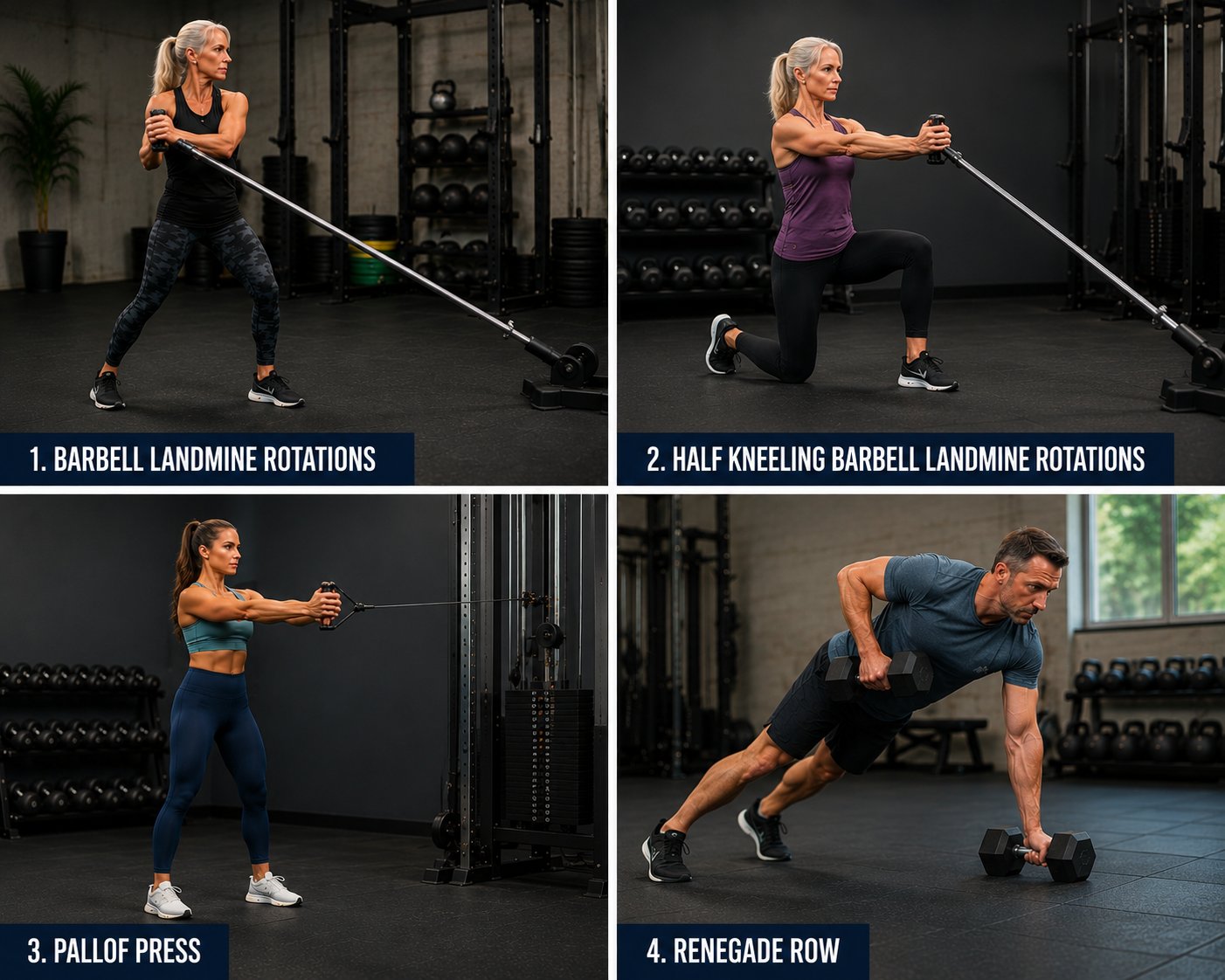
1. Barbell Landmine Anti Rotation
The barbell landmine anti-rotation is one of the best ways of combining upper-body strength with core stability, as well as learning a strong stable base.
Place one end of a barbell securely into a landmine attachment and hold the other end in one hand.
From a standing position, press the bar upwards and forwards.Rotate the bar in an overhead arc to one hip, then lift and rotate it up and overhead to the other side, keeping a super firm base and static hips.
Because the resistance is loaded dynamically from one site to another, the bar naturally tries to rotate you.
Your job is to keep your pelvis and trunk controlled while producing force through the shoulders and arms.
Why we like it
The landmine anti-rotation trains much more than the abdominals.
You’re integrating the legs, glutes, trunk, shoulder and arm into one movement.
That makes it an excellent example of how the core actually functions during sport and everyday movement.
Try: 3 sets of 8–12 controlled repetitions per side.
2. Half-Kneeling Barbell Landmine Anti Rotations
The half-kneeling landmine anti-rotation takes away some of the stability provided by standing and makes the core work even harder. A lighter bar would be normal here.
Set yourself up with one knee on the floor and the other foot planted in front.
Squeeze the glute of the kneeling leg, keep the pelvis level and press the landmine without allowing your torso to twist. Swing the bar around and down to the open hip, then back up.
The narrower base of support means even relatively modest weights can create a considerable core challenge.
Why we like it
It’s particularly useful for teaching the relationship between the hips, pelvis, ribcage and shoulder.
You can’t simply throw your bodyweight behind the bar.
You have to create stability first and then produce force.
Try: 2–3 sets of 8–10 repetitions per side.
3. Pallof Press
If you want to understand anti-rotation training, start with the Pallof press.
Attach a handle to a cable machine at approximately chest height and stand side-on to the cable.
Hold the handle against your chest, establish a strong stance and then slowly press your hands directly forwards.
The cable will immediately try to rotate you towards the machine.
Don’t let it.
Keep your hips, shoulders and ribcage facing forwards as your arms extend.
The further your hands move from your body, the longer the lever becomes and the harder your core has to work.
Why we like it
It’s simple, scalable and relatively easy to learn.
Beginners can use a very light resistance while stronger trainees can increase the load, slow the movement or introduce pauses.
Try: 2–3 sets of 8–12 slow repetitions per side, or hold the extended position for 10–20 seconds.
4. Renegade Row
The renegade row is a considerably more advanced anti-rotation exercise.
Start in a press-up position with your hands on two dumbbells.
Brace your trunk and row one dumbbell towards your ribs while keeping your hips and shoulders as square to the floor as possible.
The moment you lift one hand, your body wants to rotate.
Stopping that rotation creates a substantial challenge for the obliques and deeper trunk muscles.
Why we like it
You’re simultaneously training the upper back, shoulders, arms and core.
It’s an excellent full-body exercise, but don’t chase heavy weights.
A controlled renegade row with lighter dumbbells is far more valuable than a heavy row where the entire body twists from side to side.
A slightly wider foot position will make the exercise easier. Bringing the feet closer together substantially increases the anti-rotation demand.
Try: 2–3 sets of 6–10 repetitions per side.
Other Anti-Rotation Exercises Worth Trying
There are plenty of other ways to train the same quality.
One of my favourites is the single-arm suitcase carry.
Pick up one heavy dumbbell or kettlebell and simply walk.
The weight will try to pull you towards one side. Your job is to walk normally while remaining tall and level.
It’s wonderfully simple and extremely functional.
Other useful variations include:
- Single-arm farmer’s carries
- Offset dumbbell or kettlebell deadlifts
- Single-arm cable rows
- Bird dogs with resistance
- Half-kneeling cable presses
- Split-stance cable presses
- Single-arm dumbbell bench presses
- Dead bugs with cable or band resistance
Once you understand the principle, anti-rotation training is everywhere.
Any exercise where an uneven load is trying to move the trunk and you have to prevent it has an anti-rotation component.
Where you need to be careful
The biggest mistake with anti-rotation exercises is using too much resistance.
Remember that the objective isn’t to see how much weight you can move.
The objective is to prevent the weight from moving you.
If your pelvis rotates during a Pallof press, your body twists dramatically during a renegade row or you have to lean heavily during a landmine press, the resistance is probably too high.
Reduce the weight and regain control.
You should also be particularly careful if you currently have significant back pain or an acute back injury. Anti-rotation exercises can be extremely useful in appropriately designed rehabilitation programmes, but the correct exercise and loading will depend on the individual problem.
Another common mistake is becoming too rigid.
We’re trying to develop the ability to create trunk stiffness when it’s needed—not walk around permanently braced like a plank of wood.
Your spine is supposed to move.
Good training develops both movement and the ability to control movement.
How often should you train anti-rotation?
You don’t need a separate hour-long “core day”.
For most people, adding one or two anti-rotation exercises to two or three workouts each week is plenty.
You could, for example, finish a strength workout with Pallof presses and suitcase carries.
On another day, use landmine presses as part of your main strength programme.
As your strength improves, progress the resistance gradually while maintaining the quality of the movement.
Build a core that actually does something
Visible abdominal muscles and a strong core aren’t necessarily the same thing.
A genuinely strong core should help you transfer force, maintain position and control movement.
Crunches can strengthen your abdominals. Planks can improve trunk endurance.
But anti-rotation exercises add another important piece of the puzzle.
They teach your body to stay strong and organised while forces are trying to pull it out of position.
For sport, lifting, back health and simply staying capable as we get older, that’s exactly the sort of core strength worth training – it is also easily incorporated into our personal training sessions with industry quality resistance bands, kettlebells end medicine balls, all of which we bring to you.
Some Citations:
sources you could use:
- A 2025 umbrella review of 70 systematic reviews found that exercise therapy provides small but meaningful benefits for pain and disability in people with low-back pain and can help prevent recurrence. Motor-control exercise was among the approaches showing promise.
- A systematic review of core-stability exercise found evidence that it can reduce pain, improve function and increase core strength in people with non-specific low-back pain.
Recent Comments