Why We Love the Hex Bar: A Safer Way to Lift Heavy
If you’ve trained with us for any length of time, you’ll know we’re big fans of the hex bar deadlift (also known as the trap bar deadlift). In fact, it’s one of the first exercises we teach many new clients.
That’s because the hex bar allows people to lift heavy weights safely and confidently, while developing strength that transfers to everyday life, sport and long-term health.
Although the conventional straight-bar deadlift has its place, the hex bar offers several advantages that make it the better choice for the vast majority of people.
What Is a Hex Bar?
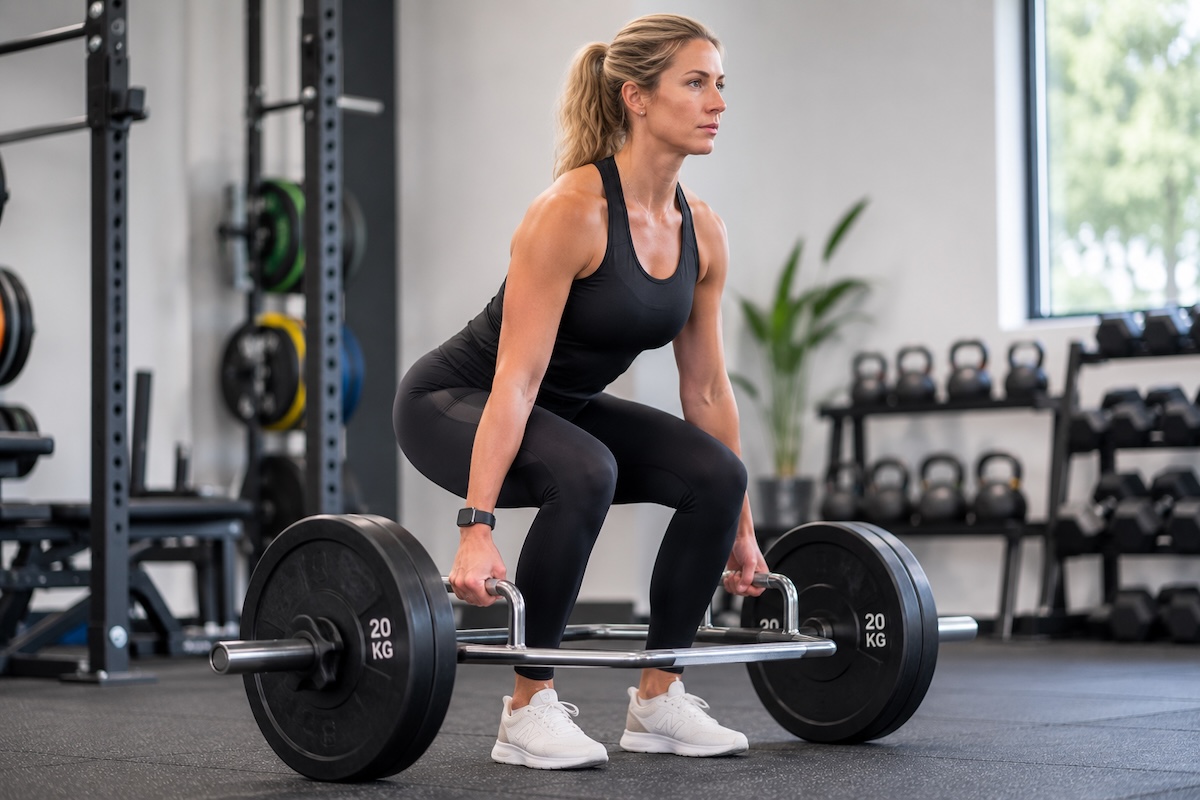
A hex bar is a six-sided bar that you stand inside rather than behind. Instead of the weight being in front of your body, it sits around you, with handles at your sides.
This seemingly simple change has a surprisingly large effect on lifting technique.
The Biggest Advantage: Better Body Position
The reason we love the hex bar is simple.
It naturally encourages a lifting position that is easier to learn and easier to maintain.
Most people using a straight bar need a combination of:
- good ankle mobility
- good hip mobility
- adequate hamstring flexibility
- excellent spinal control
If any of these are lacking, people often compensate by rounding their back or placing excessive stress on the lower back.
The hex bar changes the mechanics.
Because the load is centred around the body rather than pulling forwards, most lifters naturally:
- keep a more upright torso
- bend their knees slightly more
- maintain a more neutral spine
- keep the weight closer to their centre of mass
For many people, this immediately produces a safer and stronger lifting position.
Heavy Lifting With Less Stress on the Lower Back
Research consistently shows that the hex bar reduces the forward bending moment acting on the lumbar spine compared with a conventional deadlift.
In simple terms, your lower back doesn’t have to work quite as hard to resist being pulled forwards.
That doesn’t mean the exercise is “easy”—your back still works hard—but the load is shared more effectively between the hips, glutes and legs.
For clients who:
- are new to resistance training
- have a history of lower back discomfort
- are returning after injury
- simply want to build strength safely
this is a major advantage.
You Can Usually Lift More Weight
One of the enjoyable aspects of the hex bar is that most people can lift 5–10% more, and sometimes considerably more, than with a conventional deadlift.
This is largely because of the improved leverage and stronger body position.
Lifting heavier loads safely provides a powerful stimulus for increasing:
- muscle mass
- bone density
- grip strength
- confidence
- overall strength
Excellent for Building Powerful Legs
Compared with a straight bar deadlift, the hex bar generally involves:
- greater knee bend
- higher quadriceps involvement
- similar glute activation
- substantial hamstring contribution
The result is an exercise that sits somewhere between a squat and a deadlift.
That makes it incredibly time-efficient for anyone wanting to strengthen the whole lower body.
Easier to Learn
Teaching conventional deadlifts well takes time.
Many beginners struggle with:
- bar path
- hip hinge mechanics
- keeping the bar close
- shoulder position
- maintaining a neutral spine
The hex bar simplifies many of these challenges. In particular it helps lifting for those that might be beginning strength training in middle and older age. This is something that we specialise in that at Diets Don’t Work personal training – have a look at our 50+ fitness page!
Most people feel comfortable after only a few practice sets, allowing them to focus on generating force rather than worrying about complicated technique.
Better for Older Adults
As we age, maintaining muscle mass and strength becomes increasingly important.
Strength training is associated with:
- reduced risk of falls
- improved mobility
- better bone health
- greater independence
- lower all-cause mortality
The hex bar allows many older adults to train hard without adopting the more demanding positions required for a straight-bar deadlift.
That often means greater confidence and better long-term consistency.
The Downsides of the Hex Bar
No exercise is perfect.
There are situations where a straight bar is the better tool.
It Doesn’t Replicate Powerlifting Competition
If your goal is to compete in powerlifting, you’ll need to train with a conventional straight bar.
Specificity matters.
Slightly Less Demand on the Posterior Chain
Because the torso stays more upright, the conventional deadlift may place slightly greater demands on the spinal erectors and hamstrings.
For experienced lifters seeking maximum posterior-chain development, both variations have value.
Equipment Availability
Not every gym has a quality hex bar.
Fortunately, they’re becoming increasingly common as more coaches recognise their benefits.
What Does the Research Say?
Numerous studies comparing the hex bar and conventional deadlift have found that the hex bar often allows lifters to:
- produce higher peak force
- generate greater peak power
- move the bar faster
- lift heavier loads
- experience lower lumbar loading
Biomechanical research also shows the more upright torso reduces the moment acting on the lower back while still heavily recruiting the muscles of the hips and legs.
Why We Use It
At our studio, we’re interested in helping people become stronger—not just for the gym, but for everyday life.
Whether that’s:
- lifting grandchildren
- carrying shopping
- improving sports performance
- protecting bone health
- building muscle
- reducing injury risk
the hex bar is one of the safest and most effective ways we know to build full-body strength.
Almost every client, from complete beginners to experienced exercisers, benefits from learning this movement.
The Bottom Line
The conventional deadlift remains one of the great strength exercises.
But for most people, the hex bar deadlift offers the best balance of safety, simplicity and effectiveness.
Its design naturally encourages an excellent lifting position, reduces unnecessary stress on the lower back and allows people to train hard with confidence.
That’s why it’s one of our favourite exercises—and one we’ll continue teaching for years to come.
Recent Comments